Domain Name Taken? What to Do Next in 2026
2026-10-06 · Updated 2026-10-29 · 56 min read · Findadomain.name
What to do when the domain you want is already registered: how to read what sits behind it, what buying it really costs, and how to find a strong name that is still free
All 1,000 of the most common English words are registered as .com names. The same 1,000 words are also all registered as .net and .org names. We checked them on 5 and 6 October 2026 against the registries' own servers, together with 1,000 random two-word names and 1,000 invented words, in eight extensions each. That is 24,000 checks, and section 9 explains exactly how they were run.
The result sounds bleak, and it explains why so many naming projects stall at the same red word: taken. But "taken" is not one situation. In the same study only 39.0% of random two-word .com names were registered, and about half of those registered two-word names displayed an offer to sell. Behind the word "taken" can sit a working company, a parked page, a domain investor's price tag, an expired name on its way to auction, or a registration nobody has touched in years. Each one calls for a different move, with a different price, timeline and risk.
Most people treat "taken" as either a dead end or an invitation to start emailing strangers. Both waste time and money. The registration record, the registrar's rules and the aftermarket's prices tell you far more than an availability check does, and nearly all of that information is public and free to read. The difference between a founder who pays $40,000 for a name and one who pays $12 is usually not luck. It is knowing which of these situations they are in.
This guide covers what "taken" means in practice, how to look up a domain now that RDAP has replaced WHOIS, how to tell a for-sale name from a parked one, what taken names actually cost, how buying, brokers, backorders and disputes work in 2026, and how to choose a strong alternative when the numbers say walk away. It is built on our own measurements of 3,000 names, on ICANN and registry policy, and on the published terms of the marketplaces involved.
Contents
- What "taken" actually means: 3,000 names checked
- Look up who holds the domain
- Read what the domain shows: for sale, parked or in use
- Buying a domain from its owner
- Waiting for it to expire: grace periods, auctions and backorders
- When the holder is using your trademark
- Finding a strong name that is still free
- The decision: buy, wait, challenge or move on
- How this guide was researched
The five paths at a glance
Every taken domain leaves you the same five options, and they differ more than most guides admit. The table scores each path on four criteria, using the figures from the sections below, so you can see the trade-offs before reading the detail. Your own situation can move a score, so treat the table as a starting point, not a verdict.
| # | Path | What it involves | Cost (30%) | Odds (30%) | Speed (20%) | Risk (20%) | Final |
|---|---|---|---|---|---|---|---|
| 1 | Pick a free alternative | Another extension, a modifier, a compound or a coined word | 9 - first-year quotes of $0.98 to $89.98 in our example check, more for registry premiums | 10 - 99.7% of taken two-word .coms had a free match in another extension | 10 - registered in minutes | 7 - someone else keeps the .com and the email that strays to it | 9.1 |
| 2 | Buy at a listed price | A fixed "Buy now" price through a marketplace | 6 - median ask of $3,592 for the two-word .coms we found priced | 9 - certain once listed; 49.7% of taken two-word .coms showed a sale offer | 8 - instant to six weeks, depending on the transfer | 8 - the marketplace or escrow holds the money | 7.7 |
| 3 | Offer or hire a broker | Contact the holder, or pay a broker to negotiate | 4 - $99 to $99.99 up front plus 20% commission, on top of the price | 5 - owners can refuse; Sedo cites a 70% success rate | 5 - brokers work for up to 30 days | 6 - broker fees are non-refundable | 4.9 |
| 4 | Wait for expiry | Backorder it, or bid when the registrar auctions it | 8 - $24.99 to $79 to catch a .com, more if others bid | 2 - 76.3% of .com and .net names up for renewal were renewed | 1 - the expiry may be years away, or never come | 7 - most services charge only if they catch it | 4.6 |
| 5 | File a dispute | A UDRP or URS complaint against bad-faith use of your mark | 4 - provider fees from $1,330 before any legal help | 2 - only works against bad-faith use of your trademark | 6 - about two months at WIPO | 3 - a baseless case can be ruled abusive | 3.6 |
Cost carries 30% because most readers are naming something new and the price of the name competes with everything else the budget has to do. Odds carries 30% because a cheap path that rarely works is not cheap. Speed and Risk carry 20% each: a launch date can usually move a few weeks, but losing money to a non-refundable fee, a scam or an abusive filing cannot be undone.
The ranking holds for compound and coined names, which is what most people are trying to register. It shifts for single dictionary words, where 70.3% of the common words we checked were registered in all eight extensions, so the free-alternative path narrows and buying climbs. The rest of this guide gives you what you need to rescore the table for your own name.
1. What "taken" actually means: 3,000 names checked
A domain is taken when a registrar has created a registration for it in the registry, the database the operator of each extension runs (Verisign for .com, for example). That is the only thing the word guarantees. It does not tell you whether the name points anywhere, whether a business depends on it, whether the holder would sell, or when the registration ends. Those are separate facts, and every one of them can be checked.
The distinction matters because a quick availability check can take a shortcut: asking the Domain Name System whether a name has nameservers, which is fast and free. But a registered name without nameservers looks free, and a registry can reserve or premium-price a name that has never been registered. In our own checks, 3 of 613 two-word .com names that looked unregistered in DNS were in fact registered, as were 13 of 428 invented names that DNS did not show as registered. And of 16 common words the .io registry showed as unregistered, 13 could not be registered. A red "taken" or a green "available" label is the start of the research, not the end of it.
The study: three kinds of names, eight extensions
To measure how scarce good names really are, we built three samples of 1,000 names and checked each name in eight extensions: .com, .net, .org, .co, .io, .ai, .app and .dev. The first sample is the 1,000 most frequent English dictionary words of three to ten letters, from "time" and "people" to "machine" and "professor". The second is 1,000 random adjective-plus-noun pairs built from common words, the kind of compound a founder reaches for when the single word is gone: primecotton, earlyacademy, cuteclay.
The third sample is 1,000 random pronounceable invented words of five or six letters, alternating consonants and vowels, such as batuza or benaga. Every check went to the registry's own nameservers rather than a public resolver, and every .com that looked unregistered was confirmed against the registry's RDAP database, the authoritative record of what is registered. Most of the other results were spot-checked the same way, and the full method is in section 9.
Three findings stand out. First, single dictionary words are gone everywhere, not just in .com: 70.3% of the common words were registered in all eight extensions, and even the least crowded extension for them, .dev, had 77.3% registered. Second, scarcity collapses the moment you combine words: only 39.0% of random two-word .coms were registered, and no other extension passed 7.6%. Third, invented words split sharply by length: 78.8% of five-letter invented .coms were registered, against 38.2% of six-letter ones.
The length effect is arithmetic, not taste. With the 18 consonants and 5 vowels we used, the consonant-vowel pattern allows 18 × 5 × 18 × 5 × 18 = 145,800 five-letter names and 729,000 six-letter ones. If our sample rate holds across the whole pattern, roughly 115,000 of those five-letter names are already registered: a finite set that domain investors can work through, and evidently have. Every extra letter multiplies the space by five or eighteen, and the registered share falls with it. Compounds follow the same logic: a few hundred common adjectives times a few thousand nouns gives millions of pairs, far more than anyone can hold at about $20 a year each.
The .com base keeps growing anyway. Verisign counted 166.6 million .com registrations at the end of June 2026, and 401.6 million across all extensions, up 8.1% in a year - Verisign Domain Name Industry Brief. Growth does not change the shape of the problem, though. The short and the obvious were registered long ago; the long tail is still mostly open.
What sits behind a registered .com
Registration is only the first layer. For every registered .com in the three samples, 1,975 names in all, we loaded the homepage the way a visitor would, rendered the pages that only appear with JavaScript in a real browser, and sorted what we saw into four groups: an offer to sell, a working site, a parked or blank page, and no website at all.
This matters more than the registration figures, because it tells you who you would be dealing with. A working site usually means a company or a person who uses the name and is unlikely to part with it cheaply. An offer to sell means an investor who wants to. A parked page or no website at all means a holder who registered the name and stopped there, which is the most uncertain case and the one most worth investigating.
The holders split into users and investors, and the split follows how natural the name is. Common words are mostly in use: 61.3% had a working site and only 15.0% advertised a sale. Two-word names flip the picture, with 49.7% showing a sale offer and 20.8% a working site. Invented words had the highest share of no website at all (36.2%), the pattern you expect from names registered on speculation and left dormant.
So if your name is a compound or a coinage, a taken .com is more likely a price tag than a company. If it is a single common word, you are most likely looking at an established business or a holding valued in the tens or hundreds of thousands. One caveat on precision: the sorting is automated, and a manual review of 30 pages labelled "working site" found four that were really placeholders or investor pages, so read these shares as approximate to within a few points.
The next step is to find out which of these situations your own name is in. That starts with the registration record.
2. Look up who holds the domain
Before you visit a stranger's website or send an email, read the registration record. Since 28 January 2025, registries and registrars of generic extensions no longer have to run the old WHOIS service; the obligation was sunset under ICANN's 2023 contract amendments - ICANN. Its replacement, the Registration Data Access Protocol (RDAP), returns the same kind of record in a structured format, and ICANN points users to its free RDAP-based Lookup tool - ICANN announcement.
The Lookup tool at lookup.icann.org queries the registry and the registrar in real time and shows what they publish - ICANN Lookup. For most domains that means the registrar, the creation and expiry dates, the nameservers and the status codes. It usually does not mean the holder's name. Under ICANN's Registration Data Policy, in force since 21 August 2025, registrars must redact personal data where the law requires it and must instead publish an email address or web form that reaches the holder without revealing who they are - ICANN Registration Data Policy.
Here is a real record from our two-word sample, read through ICANN Lookup on 6 October 2026.
A real registration record, read through ICANN Lookup
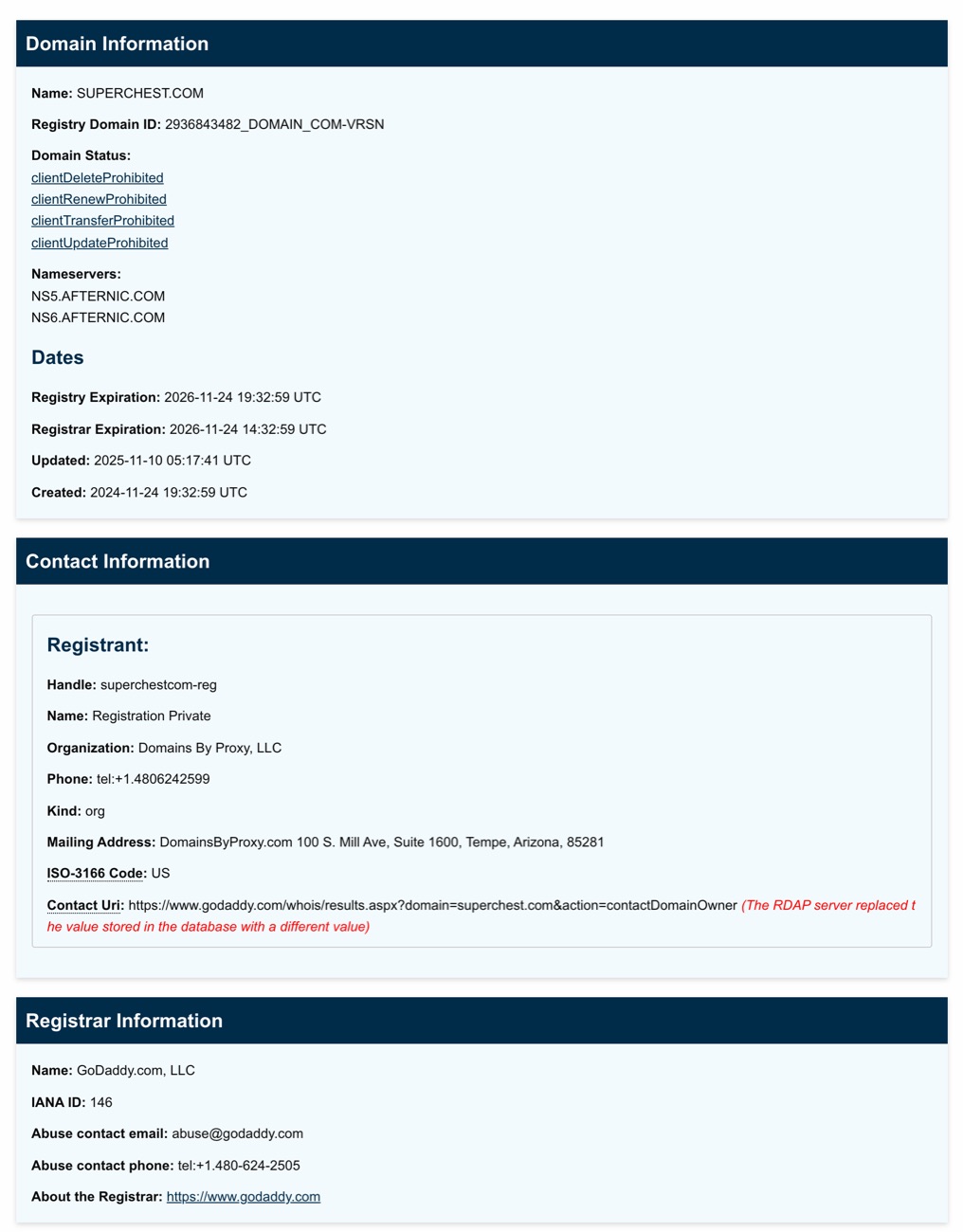
superchest.com was created on 24 November 2024 and is registered until 24 November 2026. The registrar is GoDaddy (IANA ID 146), the registrant is listed as Domains By Proxy, a privacy service, and the nameservers point at Afternic, GoDaddy's domain marketplace. The four statuses ending in "Prohibited" are ordinary registrar locks against unauthorized changes. When we loaded the domain itself, it forwarded to a sale page asking $999, with a lease option. In a few lines, the record told us this is a registration less than two years old, most likely an investor's, listed for sale, with a contact form for questions.
Five things to read in the record
Each field answers a practical question, and together they tell you which section of this guide applies to you. The dates tell you how long the holder has kept the name and when they next have to pay for it. The registrar tells you which expiry rules apply. The nameservers and statuses tell you whether the name is listed, locked, or in trouble.
None of this requires a paid tool. Any RDAP client returns the same fields, and ICANN's Lookup is enough for generic extensions. Note them down before you contact anyone, because they are your best evidence of the holder's position, and because a seller who quotes you a price will not volunteer any of them. A holder who renewed for twenty years, a registrar with a short auction timeline, or a marketplace nameserver each changes what a sensible next step looks like:
- Created date: a name registered last year by an investor is a different negotiation from one a company has used since 1998.
- Expiry date: when the next renewal is due, although auto-renewal means most names roll over silently.
- Registrar: it decides what happens after expiry, and the timelines differ (section 5).
- Nameservers: marketplace nameservers, such as Afternic's, usually mean the name is listed for sale.
- Status codes: "redemptionPeriod", "pendingDelete" or "serverHold" mean something unusual is happening.
The status codes deserve a closer look because they are the earliest public signal that a name may come free. ICANN's reference describes redemptionPeriod as the state after the registrar has asked the registry to delete the domain: the name is held there for 30 days, and five calendar days after that it is purged and becomes available for registration - ICANN EPP status codes. A name you want that shows this status is on a clock you can read. serverHold, by contrast, means the registry has taken the name out of the DNS, often over a dispute or an unpaid bill, and does not by itself mean the name is about to drop.
Contacting the holder through the record
The contact line in the record is the sanctioned route to a holder who hides their identity. In the superchest.com example it is a GoDaddy "contact domain owner" form. Your message is relayed, and you learn nothing about who reads it unless they choose to reply. That is by design: the Registration Data Policy requires that the published address or form must not identify the contact.
If you need the holder's identity for a legal reason, there is a formal path, but it is narrow. Registrars must link a disclosure-request process from their homepage, acknowledge a request within two business days and answer within 30 days, absent exceptional circumstances - ICANN Registration Data Policy. ICANN also runs a central Registration Data Request Service (RDRS), launched on 28 November 2023, for people with a legitimate interest such as intellectual property professionals, cybersecurity specialists and law enforcement - ICANN RDRS. ICANN's Board extended it until December 2027 - ICANN Board resolution.
The numbers show how high that bar is. During its two-year pilot, more than 40,400 domain names were queried and over 3,700 disclosure requests submitted; 26% were approved and 55% were denied - ICANN blog, March 2026. Registrar participation is voluntary, access is not guaranteed, and country-code domains are not covered - ICANN RDRS requestor FAQ. Wanting to buy a domain is not the kind of interest that unlocks a disclosure, so for a purchase the relay form, a marketplace listing or a broker is the realistic route.
Country-code extensions follow their own rules. Their registries decide what to publish, and their RDAP coverage varies: IANA's bootstrap file, which RDAP tools use to find each registry's server, had no entry for .co or .io when we checked on 5 October 2026 - IANA RDAP bootstrap. If ICANN Lookup cannot find a country-code domain, use the registry's own lookup page, listed in the IANA root zone database for each extension. Once you know who holds the name and on what terms, the next free check is the domain itself.
3. Read what the domain shows: for sale, parked or in use
The second free check is to visit the domain. Use a private browser window, so a marketplace does not tailor what it shows to your history, and look at where you land, not just what the page says. A name that forwards to a marketplace address, a page with a price, or a "make an offer" form is telling you the holder's intention in plain view. A working business tells you the opposite.
In our sample, the pages fell into recognisable families. Of the 541 registered .coms that displayed a sale offer, 190 came from GoDaddy and Afternic pages, 94 forwarded to HugeDomains and 41 to Atom; the rest were spread across smaller marketplaces, brokers and owners' own pages. Each family works slightly differently, and knowing which one you are looking at tells you whether you can buy at once, must negotiate, or are looking at something that only appears to be for sale.
For-sale pages
The most common sale page in 2026 is the GoDaddy and Afternic lander, which offers up to three choices: Buy now at a fixed price, Lease to own in monthly payments, and Make an offer. The example below is a demonstration listing Afternic published in June 2026, and the priced GoDaddy sale pages in our sample offered the same choices.
A GoDaddy and Afternic sale page

On a priced lander, "Buy now" takes you through GoDaddy's normal checkout; on an unpriced one, a price-request form puts you in touch with Afternic's brokerage team - Afternic sales landers. The nameservers in the RDAP record often confirm the listing: superchest.com points at NS5 and NS6.AFTERNIC.COM, which is how Afternic's Fast Transfer network serves the sale page. For names in that network, a sale moves the domain to the buyer instantly; it covers .com, .co, .io and several other extensions with a Buy Now price under $100,000 - Afternic Fast Transfer.
HugeDomains works differently. The domain forwards to a HugeDomains product page with a fixed price, and the company says it does negotiate on its domains - HugeDomains FAQ. Atom, formerly Squadhelp, sells curated brandable names, mostly at fixed prices with some lease-to-own plans - Atom. A plain text page saying "The domain is for sale. To purchase, call..." is usually a GoDaddy parking page whose holder has turned on a sale listing.
Parked pages and registrar placeholders
Parked pages are where buyers most often misread the signal. A page that says the domain "is parked free, courtesy of GoDaddy.com" with a "Get This Domain" button is the registrar's default page for a name whose holder has not set anything up. When we followed that button on pages in our sample, it led into GoDaddy's own domain search, tagged for its domain broker service; it does not mean the holder agreed to sell. A GoDaddy page saying the domain "is registered, but may still be available" is the same broker funnel.
Two other page types are worth recognising. A page saying the name "is available on GoDaddy Auctions" means the registration has lapsed and the registrar is auctioning it, which is the expired-auction route covered in section 5. A page with only "related searches" links is an advertising parking page that earns the holder small amounts per click. Neither is a sale listing, but both tell you the holder is not building anything on the name.
The practical rule is to separate what the holder chose from what the registrar shows by default. A price or an offer form set by the holder means you can negotiate today. A registrar default page means you are dealing with someone who may never have thought about selling, which makes the broker route slower and less certain, and makes the registration dates in section 2 more important.
What taken names cost
Of the for-sale pages in our study, 149 displayed a fixed price we could read. The asks for two-word names had a median of $3,592, with almost half priced between $2,500 and $5,000. Invented words were cheaper and more spread out, with a median of $2,988 and nearly one in five under $1,000. The five single-word .coms that showed a price asked between $64,998 and $990,000.
Asking prices are not sale prices, and the published sales data sits in a lower band for typical names and a much higher one for premium ones. Sedo, one of the largest marketplaces, reported a 2025 median sale price of $818 across all extensions and $595 for .com - Domain Name Wire. Escrow.com, which handles larger deals, put the Q4 2025 median at $7,500 for domains with content and $5,000 for those without - Escrow.com domain report, Q4 2025. NameBio's public database recorded about 190,300 sales worth over $244 million in 2025 - NamePros analysis.
At the top of the market, the numbers are of a different kind. The largest reported sale of 2025 was Icon.com at $12 million - DNJournal 2025 top sales, and in February 2026 the sale of AI.com for $70 million was announced, more than doubling the previous public record - DNJournal. Those are not your comparison points unless your name is a single premium word. For a compound or a coinage, the low thousands is the realistic range.
Why investors price where they do
The asks make sense once you look at an investor's costs. A .com costs the registrar $10.26 a year at wholesale, rising to $10.97 on 1 November 2026 - Verisign Q1 2026 results, and GoDaddy lists a standard .com renewal at $22.99 - GoDaddy renewal fees. Holding a single name is close to free. Holding a portfolio is not: 1,000 compounds cost roughly $23,000 a year at that retail price.
Now assume, purely for illustration, that 2% of those names sell each year. At our median ask, 20 sales of about $3,600 bring in $72,000, which covers the portfolio and pays for the names that never sell. That is the structural reason asking prices sit in the thousands for names that cost $20 to keep: each sale has to pay for dozens of names that never sell. It also explains why investors list prices rather than wait for offers: Afternic says priced domains are three to four times more likely to sell - Afternic blog.
For you as a buyer, this cuts both ways. An investor will rarely accept $100 for a name with a $3,500 ask, because their model depends on not doing that. But an investor also has no attachment to any one name, and a name that has sat unsold for years is a cost to them, not an asset they love. That is the opening the next section uses.
4. Buying a domain from its owner
Buying a taken domain is a normal transaction with a well-worn process, and most of the risk comes from skipping steps rather than from the steps themselves. The process depends on which of three situations you are in: the name has a fixed price, the name invites offers, or the holder has not signalled anything and must be approached.
The rule that runs through all three is to keep the money with a neutral party until the domain is in your account. Marketplaces do this as part of checkout. For direct deals, an escrow service does it for a fee. Paying a stranger by bank transfer or crypto before the domain moves is the classic way to lose both the money and the name.
Names with a fixed price
A fixed price is the simplest case: you pay the listed amount through the marketplace and the domain is transferred to you. On Afternic's network, names enrolled in Fast Transfer move instantly after purchase; other listings require the seller to complete the transfer by hand - Afternic Fast Transfer. Fixed prices dominate the market: Buy Now sales made up 76% of Sedo's 2025 transactions - CircleID.
If the price is too high to pay at once, several marketplaces offer instalments. Afternic's Lease to Own lets buyers pay over up to 60 months and use the domain during the lease, while it stays locked until the last payment - Afternic Lease to Own. Atom says most of its names offer lease-to-own plans, usually over 6 to 24 months - Atom premium domains. HugeDomains offers 0% payment plans, with a registrar lock until the final payment and default after three missed months - HugeDomains payment plans.
A listed price is still a starting point. HugeDomains says plainly that it negotiates, and many Afternic landers show a "Make an offer" option next to the price. A reasonable offer below the ask, made once, costs you nothing; the worst outcome is that you pay the listed price anyway.
Offers and brokers
When a name invites offers, or shows no sale signal at all, you either approach the holder yourself or pay a broker to. On Afternic, offers for unpriced names go through an in-page form to a broker - Afternic blog, and the default minimum offer on Afternic listings is $20 - Afternic. A direct approach through the RDAP contact form costs nothing, but you have no way of knowing whether anyone reads it.
Brokers exist for the cases where the holder is unresponsive or the stakes are high. A broker finds the holder, makes the approach without naming you, and negotiates inside a range you set, which is worth paying for when you suspect that your own name or company would raise the price. Their pricing is remarkably uniform across the two largest services:
- GoDaddy Domain Broker Service: $99.99 per domain up front, non-refundable, plus a 20% commission (minimum $15) if the purchase succeeds - GoDaddy.
- GoDaddy's broker window: an agent works for up to 30 days, and GoDaddy does not guarantee the acquisition - GoDaddy Help.
- Sedo buyer brokerage: $99 up front plus 20% of the purchase price on success - Sedo broker service.
- Sedo's track record: the fee is kept even if no deal is reached, and Sedo cites a 70% success rate - Sedo FAQ.
The commission is the part to plan around. On a $5,000 deal, a 20% buyer commission adds $1,000, so the broker route makes sense when the name is worth substantially more to you than the commission, or when you have no other way to reach the holder. For a name with a visible price or a working offer form, a broker usually adds cost without adding much leverage. A broker earns their fee when the holder is an operating business or a private individual who will only engage with a professional, and when you need someone to negotiate without revealing who is buying.
How to negotiate
The holder's minimum price depends on their alternatives, and so does yours. An investor holding thousands of names has a reservation price set by portfolio economics: the sale has to be worth more to them than keeping the name listed. Your strongest leverage is a credible alternative, and our data says you almost always have one: 99.7% of taken two-word .coms had at least one free match in the other seven extensions we checked. A buyer who would genuinely be happy with that alternative can make a low offer and walk away, and sellers can usually tell.
A few practices consistently help. Approach from a personal address rather than one that reveals a funded company, because "a startup with funding wants this" is the single fact most likely to raise the price. Make one specific offer with a short deadline instead of asking "how much?", which invites an anchor in the holder's favour. Keep the history of the name in view: a holder who has paid renewals for twenty years without building anything values it differently from an investor who listed it last year.
Creative structures can close gaps that cash cannot. When Notion finally moved from notion.so to notion.com in 2026, co-founder Akshay Kothari said the effort had begun in 2018, and that the final offer combined cash, equity and the chance of a private meeting with the Grateful Dead - Indian Startup News. Long timelines are normal for exact-match names: Tesla's tesla.com had been owned by one person since 1992 before it changed hands in 2016 - TechCrunch, and the company then known as TheFacebook paid $200,000 for facebook.com in 2005 - InformationWeek.
Those stories share a pattern worth copying. Each company launched on a name it could get, built something valuable, and bought the exact name when the price was justified by a real business rather than by hope. Zoom did the same, running on zoom.us for years before buying zoom.com through a broker in 2018, at a price that was not disclosed - DomainInvesting.
Paying safely and moving the domain
For a direct deal outside a marketplace, use escrow. Escrow.com charges 2.6% with a $50 minimum on deals up to $5,000 and 2.4% between $5,000 and $50,000 - Escrow.com domain fees. The buyer and seller decide between them who pays the fee - Escrow.com FAQ.
The sequence protects both sides. The buyer pays the escrow service, which verifies the funds and then tells the seller to transfer the domain; the buyer confirms receipt, and only then are the funds released - Escrow.com, how it works. The transfer itself can take anything from a few minutes to six weeks, depending on the registrars involved - Escrow.com.
One rule can surprise new owners. Under ICANN's current Transfer Policy, a registrar must impose a 60-day lock on moving a domain to another registrar after a change of registrant, unless the holder opted out beforehand - ICANN Transfer Policy. ICANN's Board adopted a revised policy in June 2026 that removes that particular lock - ICANN Board resolution, but its implementation date was still marked "TBC" in September 2026 - ICANN policy scorecard. Plan on the lock applying for now.
Most domain scams follow a few recognisable patterns, and the defence is the same for each: refuse to move money outside a neutral party.
- Pressure to pay fast outside the marketplace or escrow, often with a "discount" for doing so.
- An unfamiliar escrow site suggested by the seller, which is a common front for fraud.
- A seller who cannot show control, such as changing the page or a DNS record when asked.
- Unsolicited "appraisals" that value the name and then sell you a listing service.
The control test is the one most buyers skip. Before paying a private seller, ask them to change something visible on the domain, such as a line of text on the parked page or a DNS record you specify. Someone who controls the registration can do that in minutes; someone running a scam cannot. Inside a marketplace or escrow flow this check is built in, which is the main reason to keep the deal there even when a seller offers a discount for going direct.
5. Waiting for it to expire: grace periods, auctions and backorders
If the holder will not sell, the only other way a name changes hands is that the registration lapses. That happens constantly. In June 2026, about 97,400 .com registrations a day were deleted outside the initial grace period, by our arithmetic on ICANN's monthly registry report - ICANN .com registry report, June 2026. The final renewal rate for .com and .net names was 76.3% in the first quarter of 2026 - Verisign Q2 2026 results, so roughly one registration in four reaching its renewal date is let go.
Those numbers are encouraging only up to a point. The names that lapse are overwhelmingly the ones nobody valued, and anything with real demand is usually caught before it is ever deleted. To see why, and to know when to act, you need the sequence of stages an expiring name passes through, which is set partly by ICANN, partly by the registry and partly by each registrar.
The expiry sequence
Before the expiry date, the registrar must send the holder renewal notices, one about a month before and one about a week before, and another within five days after the name expires - ICANN Expired Registration Recovery Policy. The same policy requires the registrar to cut off the domain's existing DNS for at least the last eight days the holder can still renew. A website that suddenly shows a registrar's parking page around its expiry date is often in exactly this window.
What happens next depends on the registrar. At GoDaddy, an expired domain is parked after 5 days, can be recovered only with a redemption fee from day 18, is listed on GoDaddy's expired domains auction at day 26, cannot be renewed by its holder once there is an active bid from day 30, and is removed from the holder's account at day 72 - GoDaddy expiration timeline. Namecheap lets holders renew at the regular price for about 30 days after expiry, after which the name may be auctioned; names that are not renewed are released roughly 70 to 80 days after expiration - Namecheap.
At the registry level the stages are fixed. For .com, the auto-renew grace period is up to 45 days, the redemption period 30 days and the pending-delete period five days, during which the name is no longer in the zone file - .com Registry Agreement, Appendix 7. Restoring a name from redemption is expensive: GoDaddy's redemption fee for .com can reach $99.99 on top of renewal - GoDaddy, and Namecheap's combined redemption and renewal price for .com is $88.48 - Namecheap redemption pricing.
The final stage moved recently. From 1 October 2026, Verisign shifted the daily release of expired .com and .net names to start around 12:00 UTC, from the evening slot it used before - Domain Name Wire. The drop-catching services that compete to register names in that moment now take their final backorders by 11:30 UTC - DropCatch.
Where the valuable names actually go
Look at the order of those stages and the bottleneck becomes obvious. A name with real demand reaches the registrar's own auction around day 26, weeks before it could ever be deleted, and that is where most of the value changes hands. Only names nobody bid on continue to redemption and the drop. The 97,000 daily deletions are, by construction, mostly names the market already passed over.
The superchest.com record from section 2 shows how to use this. Its registration runs to 24 November 2026 at GoDaddy. If its holder ever let it lapse, GoDaddy's published timeline would put it on the expired auction about 26 days later, around 20 December 2026, and that auction, not a backorder, is where you would want to be watching. For a name you care about, the registrar's auction schedule is the first place to look, and the drop is the fallback.
Backorders and drop-catching
A backorder asks a drop-catching service to try to register a name the instant it is released. Most charge only if they succeed, and when several people backorder the same name, the services run an auction among them. Because the registry releases a whole day's names in one window, the services race each other to be first to register each name, which is why a name can be caught by one service while your backorder sits at another.
That competition shapes the strategy. Placing backorders at two or three services raises your chance of a catch, and you still pay only the service that succeeds, though a contested name will go to that service's auction. The prices for .com in October 2026 are low compared with buying a name outright:
- DropCatch: $59 per .com backorder, charged only if caught; several backorders lead to a public three-day auction - DropCatch.
- DropCatch Discount Club: $13 to $58, but only awarded when no regular backorders exist - DropCatch Discount Club.
- SnapNames and NameJet: now one platform, free to place, paid only for auctions won; pending-delete auctions are private - SnapNames FAQ.
- Dynadot: free to place and paid only if caught, with a public auction of 7 to 10 days when several people want the name - Dynadot backorders.
- Gname: priced by "channel", from $65 down for .com, with the deposit refunded if the catch fails - Gname.
The absence on that list is telling. GoDaddy stopped selling backorders in August 2024, saying "the vast majority of backorders aren't capturing names" - GoDaddy. That is the structural problem in one sentence: the valuable names are auctioned before they drop, and the ones that do drop attract competing catchers. A backorder is a cheap option on an unlikely event, and it is worth placing for exactly that reason, as long as you do not pause your naming decision while you wait.
The practical approach is to treat waiting as a parallel track, never the plan. Note the expiry date from the record, watch the registrar's auction around day 26 if the name lapses, place a backorder or two with services that charge only on success, and keep working on an alternative. If the name comes back, you get a pleasant surprise; if not, you have lost nothing but a calendar reminder.
6. When the holder is using your trademark
Everything so far assumes the holder has every right to the name. Sometimes they do not. If someone registered a domain that copies your trademark in order to profit from it, you can ask a dispute provider to transfer it under the Uniform Domain-Name Dispute-Resolution Policy (UDRP), which every ICANN-accredited registrar has adopted, along with some country-code managers - ICANN UDRP policy.
The UDRP is narrow by design, and that is the part most people misread. It is not a way to take a name from someone who simply registered it first. To win, the complainant must prove all three elements: the domain is identical or confusingly similar to a mark in which the complainant has rights, the holder has no rights or legitimate interests in it, and the domain was registered and is being used in bad faith - UDRP, paragraph 4(a). The policy limits the remedies to cancelling the domain or transferring it to the complainant, so there is no money award.
Costs, timing and the record
The fees are modest next to court. At WIPO, the largest provider, a complaint about one to five domains decided by a single panelist costs $1,500, and $4,000 with three panelists - WIPO fees. At the Forum, a single-member panel costs $1,330 for one or two domains - Forum UDRP fee schedule. WIPO says a case without procedural issues is normally completed within two months of receiving the complaint, and that panels cannot award money or lawyers' costs - WIPO guide to the UDRP.
Disputes have been rising steadily. WIPO managed over 6,200 domain name cases in 2025, which it called its highest caseload on record - WIPO, January 2026.
Filings rose from 3,693 in 2019 to 6,282 in 2025, with a small dip in 2024. A busier dispute system does not widen what the policy covers, though. Every one of those cases still had to show bad faith, and none of them helps a founder whose desired name was registered in good faith by someone else first.
Faster and stronger tools
For newer extensions there is a quicker option. The Uniform Rapid Suspension (URS) system offers a cheaper, faster path for the clearest cases of infringement - ICANN. It requires clear and convincing evidence and only suspends the domain for the rest of its registration period instead of transferring it - URS procedure. It does not apply to .com or .net - GNSO report. At the Forum, a URS filing for up to 14 domains costs $375 - Forum URS fee schedule.
In the United States, the Anticybersquatting Consumer Protection Act lets a court award statutory damages of $1,000 to $100,000 per domain name - 15 U.S.C. 1117. Its bad-faith factors include offering to sell the domain to the mark owner for financial gain without having used it for a genuine business - 15 U.S.C. 1125. Court is slower and costlier than the UDRP, but it is the route when you also need damages or the holder is beyond a provider's reach.
The risk of overreaching
The same rules punish complaints without a basis. The UDRP Rules define Reverse Domain Name Hijacking as using the policy in bad faith to try to take a domain from its holder, and a panel that finds a complaint was brought in bad faith must say so in its decision - UDRP Rules. A company that files against a dictionary-word domain registered years before its own trademark is the textbook case, and the finding is public.
The more common lesson runs the other way: check trademarks before you fall in love with a name, because a free domain is not a cleared name. Clubhouse, a project-management tool on clubhouse.io, renamed itself Shortcut in 2021 after the Clubhouse audio app grew so fast that it could not keep its own brand standing - Shortcut. In 2025, OpenAI removed every mention of its "io" device brand from its materials after a court order in a trademark case brought by a company called iyO - Fortune. Our naming checklist explains how to run a basic conflict check before you register anything.
7. Finding a strong name that is still free
For most people, the best path is the first one in the table. Our study shows why: the scarcity is concentrated in a narrow band of names (single words and short coinages in .com), and just outside that band almost everything is open. 99.7% of the taken two-word .coms, and 99.5% of the taken invented ones, had at least one free match among the other seven extensions we checked.
Single dictionary words are the exception, and the data shows how expensive the leftovers are. For the common words still unregistered in newer extensions, we asked the availability service behind our finder for live quotes. Every available common word we priced in .co and .dev was a registry premium, as were 18 of 19 in .app. Thirteen of the 16 unregistered common words in .io could not be registered at all. By contrast, every unregistered two-word and invented .com we priced was available at the standard $19.99 a year.
The premium quotes ranged widely: from $140 to $7,000 a year in .co, $61.25 to $998.75 in .app and $111.25 to $1,623.75 in .dev. Premium pricing also tends to persist. Namecheap explains that registry premiums often carry special pricing for renewal and transfer, not just registration, while a name bought from an existing owner usually renews at the normal price - Namecheap. Porkbun adds that some premiums renew at the standard price and others stay premium, so check the projected renewal at checkout - Porkbun. Under ICANN's standard registry agreement, a premium renewal is allowed only if the buyer was clearly told and agreed at registration - ICANN base registry agreement.
Five ways to find a free version of your name
There are only a handful of moves, and each trades something different. A modifier keeps your word and lengthens the address. A new extension keeps the address short and changes how people remember it. A compound or a coinage gives up the obvious word for a name you can own in every extension.
The right one depends on what the name has to do. A local business mostly needs to be found by people who already know it; a product that will be typed from a podcast mention needs to be spelled correctly on first hearing; a company that plans to raise money needs a name it can protect. These are the moves, roughly in order of how often they produce a good result:
- Compound it: join your word with a second one that says what you do or where (field notes coffee, harbor and vine).
- Coin it: six or more letters, pronounceable, tested by saying it aloud to someone who has to write it down.
- Change the extension: keep the exact name in .co, .io, .ai, .app or a country code that fits your market.
- Add a modifier: get, try, use, hq or app around the word, best for products whose brand is the bare word.
- Hack the domain: let the extension finish the word, as in del.icio.us, if you can live with spelling it out.
The order reflects our data and the trade-offs below. Compounds and coinages are where the free .coms are, which keeps the strongest default extension in reach: 61.0% of our random two-word .coms and 61.8% of six-letter coinages were unregistered. A different extension is the fastest fix but carries the costs covered next. Modifiers work for products whose users already know the brand. Domain hacks are memorable but hard to say aloud, which is why we cover them in their own domain hacks guide.
Short names are the other place people look, and in .com that door is closed. On 23 October 2026 we asked the .com registry about every three- and four-letter name: all 17,576 three-letter .coms and 456,973 of the 456,976 four-letter ones are registered, and the last three (gnso, iesg and imso) cannot be registered either. At five letters only 24.2% of a random sample are registered, but most of the free ones are strings nobody can say; among pronounceable five-letter names, 75.8% are taken. The same counts for .net, .org, .io, .co and .ai are in our short domain names study.
Going down the dictionary does not help much either. On 29 October 2026 we checked all 172,541 words of an English dictionary at the .com registry: every one of the 25,000 most common is registered, as is every dictionary word of five letters or fewer. The most common word still free was phosphorylated. The 36,877 unregistered words, most of them long, technical or archaic, are listed in our one-word .com domains list.
Choosing an extension with open eyes
Google does not penalise newer extensions. It said in 2015 that its systems treat new generic extensions like .com and .org, and that keywords in an extension give no ranking advantage or disadvantage - Google Search Central. It also treats a list of country codes, including .ai, .co, .io, .me and .tv, as generic rather than tied to a country - Google Search Central.
The real differences are cost, rules and politics. .ai passed one million registrations in January 2026, up about 67% in a year - Domain Name Wire, raised its wholesale price by 14.3% and still requires a two-year minimum - Domain Incite. .io belongs to the British Indian Ocean Territory; ICANN has said that if the code were ever retired, its policy would give a five-year window to phase it out - ICANN, and the UK and Mauritius treaty on the territory had not entered into force as of October 2026 - Al Jazeera. .dev is on the HSTS preload list, so every .dev site must use HTTPS - Google Registry. If the name you are weighing is for an AI product, the next thing it needs is evidence that the product works in its field, and AITraining.jobs' expert data service, a business owned by the same company as this guide, has professionals write and grade that evaluation data.
Country codes add a risk that generic extensions do not: the country's registry sets the rules and can change them. In 2010, Libya's registry seized vb.ly over content it judged contrary to local law - TechCrunch, and in July 2026 Telegram's t.me short-link domain, on Montenegro's .me, was put on hold for about a day, which DomainME, the company that manages .me, attributed to US sanctions compliance - TechCrunch. Our extension guides cover the rules and typical prices of each extension, including .ai, .io and .dev.
The cost of not owning the .com
If you launch on another extension while someone else holds the .com, some of your traffic and email will go to them. People default to .com: in a 2022 survey of 1,500 people, they were 3.8 times more likely to assume a remembered address ended in .com than in anything else - GrowthBadger. A 2025 survey commissioned by GoDaddy, which sells domains, found that 74% of consumers are more comfortable when a domain matches a brand name exactly - GoDaddy.
Misdirected email is the part with real consequences. In 2023, the contractor who manages Mali's .ml domain reported close to 117,000 misdirected messages meant for US military .mil addresses - ABC News. In 2026, a researcher who bought noreply.net said it had received 400,000 messages in a year and a half, more than 28,000 of them with attachments - Ars Technica. If you launch on example.co while a stranger holds example.com, every customer who types the wrong ending sends their message to that stranger.
The mitigations are simple, if not free. Put the full address on everything, say the extension out loud in podcasts and talks, and register the obvious typo and extension variants you can afford. If the .com becomes affordable later, buy it then, as Notion, Tesla and Zoom eventually did. Airbnb began as Airbed & Breakfast and changed its name in March 2009 - Airbnb; the name you launch with does not have to be the name you keep.
Domain hacks: clever, with costs
A domain hack uses the extension to complete a word, and it has a long history of both success and regret. Instagram launched on instagr.am in October 2010 - WIPO case D2014-1550, and the bookmarking site del.icio.us became famous under its hack before rebranding to delicious.com in 2008, after what its team called "a zillion different confusions and misspellings" - Domain Name Wire.
Hacks work best as a short link or a second address beside a spoken name, not as the only way people can find you. They inherit every risk of their extension, which for a hack is usually a country code. Our domain hacks guide explains how to test whether a split reads naturally before you commit.
Checking a name across extensions
The fastest way to see the whole picture for one name is an exact-name check across every extension, with prices and terms side by side. Our own finder, Findadomain.name, does this: it checks an exact name across hundreds of extensions (584 for the example below) and shows the registrar quote and any known minimum term for each available result. It can also generate brandable alternatives when you would rather start from an idea than a fixed word.
The same taken name, checked across extensions
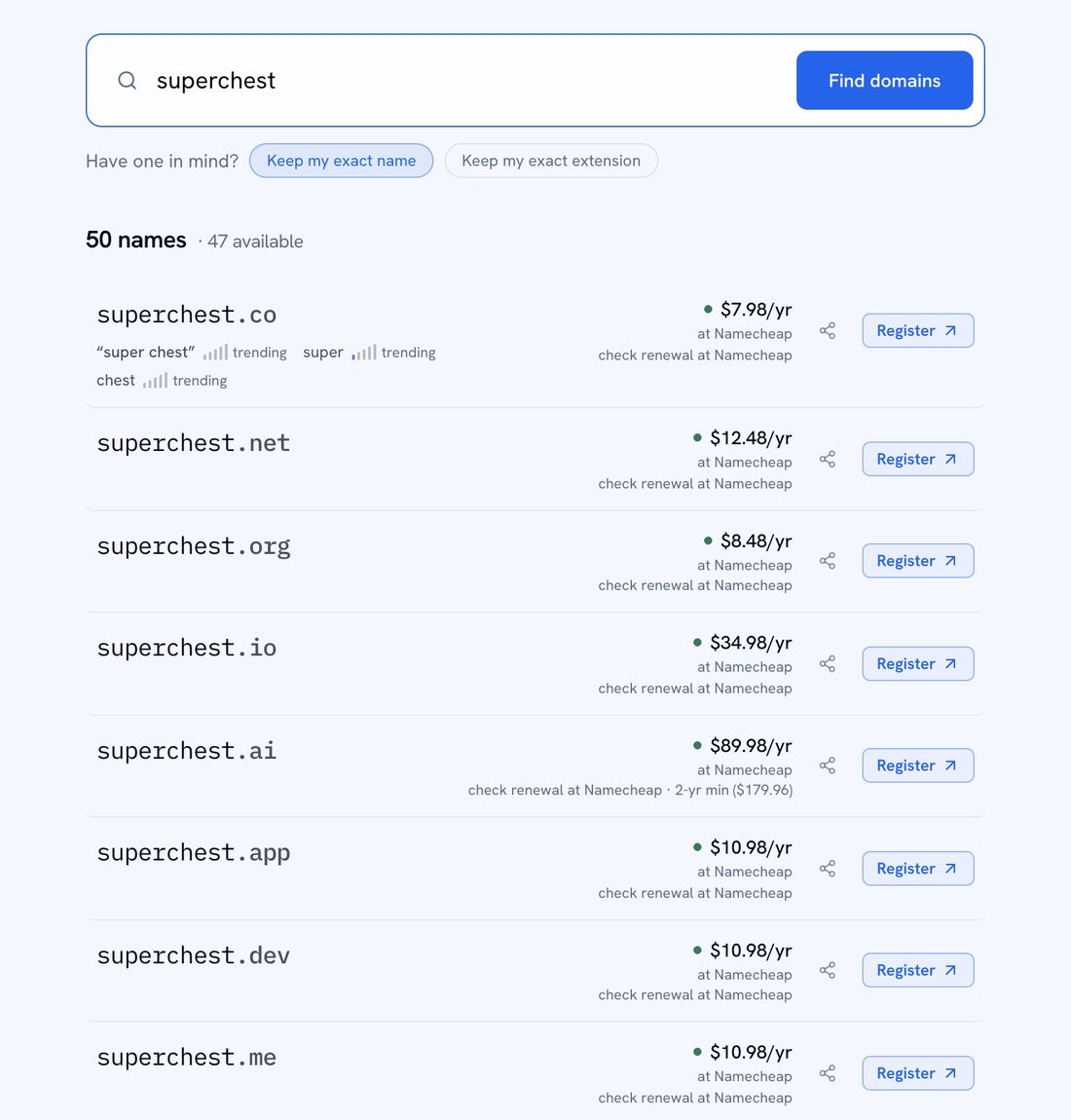
For "superchest", 47 of the first 50 extensions were available on 6 October 2026, with first-year quotes such as $7.98 for .co and $89.98 a year for .ai, which carries a two-year minimum. Those first-year prices are the hook, and the renewals are the bill: several of the cheapest results in the full list ran under a dollar for year one with renewal prices the result asks you to confirm. Before choosing, compare five-year costs, not first-year promotions; our domain cost calculator does that arithmetic for any two quotes.
If you prefer to hear the same advice from a registrar's perspective, Wix's September 2026 walkthrough on choosing a domain includes a chapter on what to do when the name is taken, starting at 3:47.
Its chapters run from what makes a good name, to the taken-name case, to the mistakes to avoid, which is the same order of decisions this guide recommends: understand the name first, then treat a taken result as a reason to look sideways before you look at your wallet. Whichever route you take, the last step is the same, and it is the subject of the next section: deciding when a taken name is worth paying for.
8. The decision: buy, wait, challenge or move on
By this point you have the evidence to decide: what the record says, what the domain shows, what similar names cost and what your alternatives are. The decision is a comparison between two numbers: the price of the exact name and the cost of the compromise. The price is visible. The cost of the compromise is not, and it is where most people's judgement slips.
The cost of the compromise has three parts. The first is lost traffic and mail, which grows with how much word of mouth your business depends on. The second is brand risk: a stranger's .com that hosts something embarrassing, or a competitor that buys it later. The third is friction, every time you spell out an unusual extension. For a side project, all three are close to zero. For a consumer brand that expects to be talked about, they can be worth thousands a year.
Every branch ends in the same place if the first route fails: a free alternative. That is deliberate. The most expensive mistake in this process is not overpaying for a name; it is delaying a launch for months while waiting for a name that may never come.
Three worked examples
Consider a two-word name whose .com shows a Buy Now price of $3,500, close to our median, and whose .co is free. The .co costs a few dollars in its first year, and the gap of about $3,500 is the price of the compromise. For a newsletter or a side project, that money buys nothing the .co cannot do. For a consumer brand that will spend more than $3,500 on its launch anyway, the exact .com is probably worth it, especially with a lease-to-own plan spreading the cost.
Now take a single common word whose .com is a working business. The record shows a twenty-year-old registration and a company site. There is no price to compare and no realistic route to one, short of a broker approach that starts with $99.99 and may end in a six-figure ask. The right move is to compound or coin a name now, and treat the exact word as a possible upgrade if the business ever justifies it.
Finally, take a coined word whose .com shows a parked page and an expiry date four months away, at a registrar that auctions expired names. A backorder costs nothing unless it succeeds, and a calendar reminder for day 26 after expiry costs less. Place both, then launch on a free variant. If the name comes back, you can move to it; if it does not, you lost nothing. When the comparison involves renewals as well as purchase prices, our domain cost calculator puts both options on a five-year footing.
9. How this guide was researched
The availability figures come from our own checks, run on 5 and 6 October 2026. The three samples were built in code with fixed random seeds: the 1,000 most frequent English words of three to ten letters that the WordNet dictionary lists, excluding proper nouns; 1,000 random pairs of common adjectives and nouns; and 1,000 random pronounceable strings of five or six letters that are not English words. Each name was checked in eight extensions, 24,000 checks in all, by asking each extension's own nameservers whether the name was delegated.
Because a registered name can lack nameservers, every .com that looked unregistered was confirmed against the registry's RDAP database, as were random samples of up to 60 such names in each other extension, and the shares were corrected accordingly. For two-word and invented names, 0% to 2.4% of the apparently free names turned out to be registered. For common words the share was higher, up to 10 of 26 in .io, because registries keep many dictionary words registered to themselves or held back. One registry's server limited our requests, so the invented-word results for .io and .ai rest on the DNS check alone. Homepages were fetched for all 1,975 registered .coms, and pages that need JavaScript were rendered in a headless browser before being sorted by rules that look for sale offers, parking pages and working sites. Prices were read from the sale pages that displayed one, and premium quotes came from the availability API behind our finder. The per-name registration results are free to download and reuse under CC BY 4.0: see the taken domain names dataset, which is also archived on Zenodo with the scripts behind it ( doi:10.5281/zenodo.23288857).
The policy and market research followed what is often called the supervisor pattern: one coordinating agent split the questions, five research agents each took one topic and had to fetch and quote the page behind every fact, and every link in this guide was fetched again before publishing. Findadomain.name is built and run on Founden, a platform owned by the same founder as this site, and Founden's playbook for orchestrating parallel AI agents explains how that pattern works and where it fails.
Two limits are worth stating. A snapshot of 3,000 names describes the shape of the namespace, not the status of your particular name, which can change any day. And automated page sorting makes mistakes at the edges, which is why the shares in section 1 should be read as approximate. If you check a name with our finder or any other tool, the registry's own record, read through RDAP, is the final word.
Correction, 9 October 2026: the invented-word shares for .net, .org and .co were first published as 17.1%, 15.0% and 7.2%. Their correction rate had also counted names whose DNS check failed, which were looked up because the check failed rather than at random. Using only the random samples of names without nameservers, as described above, gives 15.9%, 12.6% and 7.3%, and the share of apparently free two-word and invented names that turned out to be registered is 0% to 2.4% rather than 0% to 3%. No other figure changed.
Conclusion: start from the evidence, not the label
"Taken" is the beginning of an investigation, and the investigation is short. Read the RDAP record for the age, registrar, nameservers and expiry. Visit the domain to see whether the holder is selling, using or ignoring it. Compare any price with the cost of your best free alternative, and remember that for compound and coined names, a good alternative almost always exists.
The numbers point to a clear default. Single dictionary words are spoken for in every extension we checked, and the few left over are mostly registry premiums. Two-word names and six-letter coinages are still largely open, and about half of the taken two-word .coms are openly for sale at prices in the low thousands. Waiting for an expiry is a cheap side bet, not a plan, and a dispute is only for genuine bad faith against a trademark you hold.
If the exact .com is for sale at a price your business can carry, buy it through a marketplace or escrow and move on. If it is not, pick a strong free version, launch, and keep the upgrade in mind for later, as Notion, Tesla and Zoom did. To see your own options side by side, run your name through Findadomain.name with "Keep my exact name" turned on, then check the renewal terms before you register.
This guide reflects registry data, marketplace terms and policies as of 6 October 2026. Prices, policies and the availability of individual names change frequently, so verify current details with the registry, registrar or marketplace before you buy.